

By
Ola Olateju
Lessons from Achievers University’s Convocation for Nigeria’s Youth, Universities, and the State
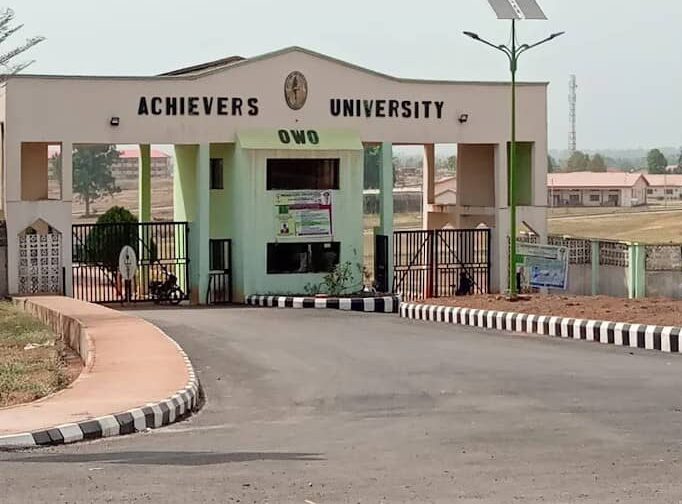
The 15th Convocation and 18th Foundation Anniversary of Achievers University, Owo, was not merely a celebration of academic milestones; it was an intellectual convergence – a moment when personal life lessons, institutional accountability, and national policy failures met in one space. Taken together, the Convocation Address of the Acting Vice-Chancellor, Professor Oyesoji Aremu, and the Pro-Chancellor’s Address by Professor Bode Ayorinde formed a compelling national dialogue on what education means, what it costs, and what Nigeria risks losing if it continues on its present path.
Like Alhaji Lai Mohammed’s convocation lecture, which was delivered a day earlier, both speeches rejected complacency. They addressed not only graduating students but also parents, policymakers, regulators, and the Nigerian government. They emphasized, each from a different viewpoint, that education is not an ornament of society but its driving force; not a commodity to be exploited but a public good to be safeguarded.
Professor Aremu framed the convocation moment as both an end and a beginning, a pause between achievement and responsibility. He reminded graduands that they are not mere statistics but testimonies, products of perseverance in a system that often tests resilience more than intellect. Yet, like Lai Mohammed, he warned against the illusion that a degree is a destination. It is, at best, a passport, useful only if character, emotional intelligence, and social competence accompany it.
Invoking Daniel Goleman’s insight that career success depends far more on emotional and social intelligence than on raw IQ, the Acting Vice-Chancellor reinforced a central lesson Nigeria desperately needs to relearn: intelligence without character is fragile capital. Degrees may secure appointments, but it is integrity, discipline, and relational intelligence that sustain relevance. In a country where leadership failure often stems from moral bankruptcy rather than intellectual deficiency, this emphasis is both timely and unsettling.
The institutional philosophy of Achievers University, as articulated by Professor Aremu, reflects this understanding. The university’s insistence that no graduate should leave with “only a degree” is not a marketing slogan; it is a strategic response to a volatile labour market and a rapidly changing global economy. The introduction of additional certificate and diploma programmes, the establishment of the Institute of Diplomatic Practice, Culture and Language Development, and the deliberate focus on employability skills all mirror the core message of Lai Mohammed’s lecture: survival in the modern world depends on adaptability and continuous reinvention.
The university’s scorecard further demonstrates what disciplined leadership can achieve even within Nigeria’s hostile higher education environment. The graduation of 705 students across undergraduate and postgraduate programmes, the strong showing of First Class and Second Class Upper Division graduates, the global recognition earned by a final-year engineering student through cutting-edge research in machine-learning–based medical diagnostics, and the stellar performance of pioneer Law graduates at the Nigerian Law School all speak to a culture of seriousness. These are outcomes of investment, vision, and insistence on standards and not luck.
Equally significant is the steady development of the College of Medicine, in partnership with the Federal Medical Centre, Owo. At a time when Nigeria is bleeding medical professionals to emigration, Achievers University’s focus on producing competent and compassionate doctors represents a quiet but critical intervention in the national health crisis. Modern laboratories, teaching hospitals, ICT-enabled learning facilities, and compliance with regulatory standards show that private universities can be strategic partners in national development, only if policy allows them.
It is at this point that Professor Bode Ayorinde’s address enters the conversation with moral clarity and policy urgency. While the Acting Vice-Chancellor presented what universities are doing right, the Pro-Chancellor confronted what the government is doing wrong. His speech, titled “Rethinking Taxation in the Education Sector: Why Educational Institutions Should Not Be Taxed,” was a direct challenge to Nigeria’s fiscal logic.
Professor Ayorinde reminded the audience that Achievers University itself was born out of vision and sacrifice, rising from a virgin forest in 2003 to a fully accredited institution with 35 programmes and over 5,000 students. Yet, despite this contribution, private universities are treated as commercial enterprises, burdened with multiple layers of taxation that consume a significant portion of tuition fees. From local government levies to VAT, company income tax, development levies, and personal taxes on proprietors, education is being taxed as though it were a luxury consumption.
Most troubling is the irony embedded in the new development levy under Nigeria’s 2025 tax reforms, whereby private universities are compelled to contribute to TETFUND, a fund from which they are categorically excluded. In effect, students in private institutions are taxed to fund public institutions alone. As the Pro-Chancellor bluntly puts it, this is not policy coherence; it is policy injustice.
Professor Ayorinde’s argument is fundamentally philosophical: education should never be taxed. It should be supported, subsidised, and incentivised. Taxing education is equivalent to taxing knowledge, opportunity, and the future. Universities, even when privately owned, are non-profit in nature; surplus is reinvested into infrastructure, research, scholarships, and staff development. Burdening them with taxes inevitably leads to higher tuition fees, reduced access, curtailed scholarships, and discouraged investment in education.
Drawing from global best practices, he demonstrated that Nigeria is out of step with the world. In the United States, United Kingdom, Canada, Australia, and South Africa, universities enjoy tax exemptions and fiscal incentives because education is recognised as a public good. These societies understand that the long-term economic and social returns of education far outweigh any short-term tax revenue. Nigeria, by contrast, taxes the very engine it expects to drive industrialisation and innovation.
The Pro-Chancellor’s warning is stark: no nation industrialises by weakening its universities. No knowledge economy emerges by taxing research, innovation, and learning. Every tax imposed on universities ultimately becomes a tax on students, parents, and society at large. The contradiction is painful; we demand world-class universities, yet deny them world-class support.
Together, the speeches of Professors Aremu and Ayorinde form two halves of a single truth. One shows what is possible when institutions are guided by vision, character, and discipline. The other exposes how misguided policy can undermine those very efforts. Both converge on the same conclusion: Nigeria must urgently rethink its relationship with education.
For the graduating students, the lesson is personal and moral. Go forth with courage. Shun social vices. Build character alongside competence. Be prepared to reinvent yourself repeatedly. Achievers University has given you tools; history will judge what you build with them.
For the government, the lesson is structural and urgent. Education must be removed from the tax net. Private universities must be treated as partners, not revenue sources. TETFUND must be reformed to include all institutions contributing to national human capital development. Anything less is discriminatory and self-defeating.
For Nigeria, the message is existential. You cannot tax the engine of progress and expect the nation to move forward. Education is the heart of development, the backbone of innovation, and the seedbed of leadership. To weaken it through policy incoherence is to mortgage the future.
Achievers University’s convocation thus becomes more than a ceremony. It becomes a mirror reflecting what Nigeria can achieve when vision is matched with integrity, and warning what it stands to lose when policy forgets purpose.
OLA OLATEJU FROM ACHIEVERS UNIVERSITY, OWO, ONDO STATE

