

By
Rahman Owokoniran
The suspension of the elected Rivers State Government by the President was nothing more than a dirty slap on the face of its people. It was nothing short of a demonstration of strength, show of power, tendency to tyranny and authoritarianism and determination to keep the Governor and other elected officials in check.
And it worked for the President.
Thereafter followed the spontaneous movement of most of the PDP Governors and National Assembly members to the ruling party’s headquarters for admission to the party.
Gov. Fubara on the other hand was either too weak to handle the situation or he was playing a script handed over to him by his boss, Nyesom Wike, President Bola Ahmed Tinubu’s Minister of the Federal Capital Territory. How else would anyone explain Fubara’s decision to seek for resolution of the conflict between himself and Wike in the hand of the President that decreed an unlawful declaration of emergency as an excuse to prevent violence against whom, by whom?
The end result upon expiration of the term of the reconciliation agreement between Fubara and Wike is telling on what the declaration of emergency was really about. Governor Fubara did not demonstrate courage when he refused to challenge President Tinubu’s unlawful declaration of a state of emergency in the circumstances surrounding a peaceful protest against the government and its actions. Invoking a law to prevent such protests in this case was an attempt to silence critics of the ruling party who had been accused in the first instance. The President’s move was a major blow against the state government. The more reason why it was not in the interest of the state to make a deal with the President.
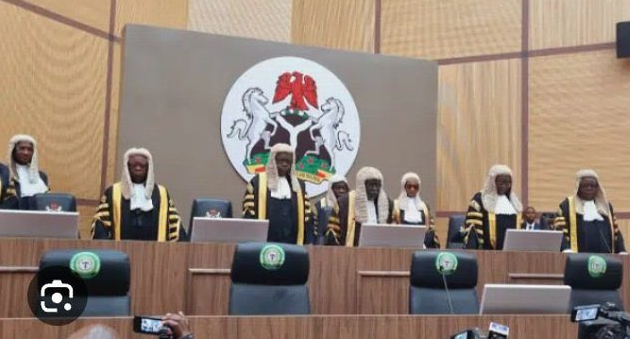
If the Governor had challenged the matter in court, the resultant Supreme Court ruling would have been subjected to an extraordinary constitutional interpretation of the law and it would have reflected the limitations of the President to declare a state of emergency. But in this case, the court recused itself from ruling on the matter since it had struck out the suit for want of jurisdiction to determine the case on its merits.
Still the majority of six out of seven justices extended their judgments stating that the President had the power to declare a state of emergency without specifying the limitations of such authority in order to prevent a constitutional crisis; in which case the court judgment would have interpreted the Constitution and its provisions rather than application of the law as an expression of the Constitution.
The recent Supreme Court pronouncement of the President’s power to declare a state of emergency and suspend elected officials raises serious constitutional concerns about whether or not the President should have the power to do so. It makes him a tyrant.
The ruling jettisons popular democratic election for authoritarian, dictatorial and tyrannical selection by one individual, even if he is the President.
This questions our democratic process and its implications on our constitutional rights as well as our liberties and freedoms of expression in our society.
While the constitution provides emergency powers to preserve national stability, such powers were never intended to undermine the rule of law and the right to liberty and freedom to choose their leaders. And the Constitution remains the most important document of our time as a guiding light of democracy. The Federal Republic of Nigeria remains united in its own right as a sovereign nation with its power structures and political institutions in an equilibrium with its people. Democracy thrives on checks and balances, not absolute discretion.
Emergency rule should remain an exceptional last resort, not a convenient political tool for even the President of the Federal Republic of Nigeria. Suspending elected officials who derive their mandate directly from the people must be approached with extreme caution, a clear warning to the public about their actionable intentions, especially the due process such as the Constitutional requirement, the legislative oversight and the clearly defined limits. Anything short of the above risks setting a dangerous precedent that could erode democratic trust and legitimacy and undermine democratic institutions and the rule of law in this nation.
Nigeria’s strength lies in its diversity, constitutional order, and respect for the rule of law not in the personalization of power. True stability is achieved through dialogue, justice, accountable leadership, and respect for democratic norms and values that enable all parties to participate in the process to achieve their goals and objectives in a positive and sustainable manner.
The African Democratic Congress (ADC) remains firm in its belief that power must always serve the people, not intimidate them. ADC stands as the only political party consistently committed to: Restructuring of the system, Decentralization of power, Social Security Reforms, Entrenched Democratic Institutions and the mandates at all levels of government.
We urge all arms of government to exercise restraint, uphold democratic values, and remember that authority is a responsibility, not a weapon for a forceful or immoral regime of tyranny.
Nigeria must be governed by law, not by fear say.
HON. OWOKONIRAN WRITES FROM THE ADC MEDIA NETWORK 2.0

