

BOOK REVIEW
BOOK: The Gun Hegemony
AUTHOR: Ayo Opadokun
PUBLISHER/YEAR: Bonafidea Nigeria Limited, Lagos, Nigeria –2025
PAGES: 428
PRICE: Unstated
In The Gun Hegemony, Ayo Opadokun, who wore two hats as Secretary of the National Democratic Coalition (NADECO) and Secretary of the Yoruba socio-political group, Afenifere, has delivered a highly comprehensive and authoritative third-party, multi-sourced narrative on the Nigerian Military.
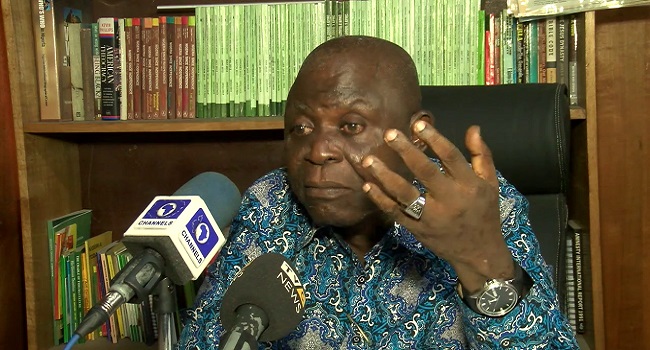
Riding on the hypothesis that Military incursions have afflicted Nigeria with more harm than good, Opadokun submits in the book that officers who planned the first coup and subsequent ones only succeeded in inflicting the country with mediocre leadership and great disservice. The uniformed men abandoned their core responsibility and primary assignment to meddle in governance. Opadokun’s judgement? They failed woefully in both.
In overthrowing civilian regimes and taking over government, Opadokun submits, the Nigerian Military chased two rats and lost both. The officer corps ended up being neither effective governors nor efficient professionals when they took over the reins of government. Nigeria’s Military rulers flopped in both soldiering and governance.
The Author has delivered a well-researched volume, which must be credited for its great depth and expansive coverage. The NADECO Secretary’s effort will surely rate as one of the best-researched books on the country’s Military history. Opadokun traces the beginnings of today’s Nigerian Army to the colonial era with the emergence of the “Glover’s Hausas.” That foundation, he said, began the northernisation of the Military, a malady the country has found itself unable to cure and which, he says, accounts for the preponderance of Military formations in the North to the detriment of the South. It also explains the powerful influence the North continues to wield over the Military.
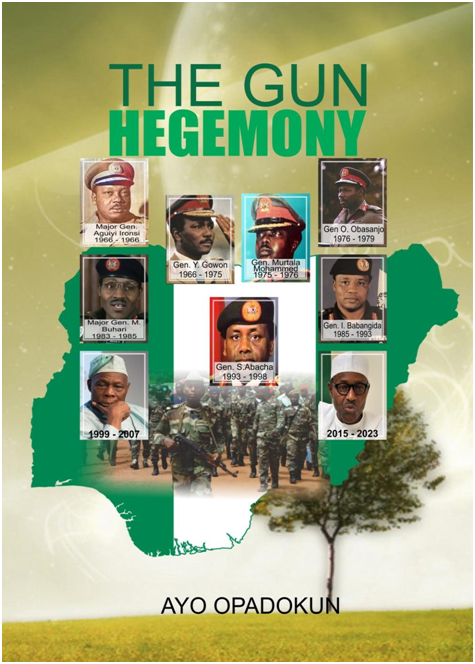
The Gun Hegemony traces not just Nigeria’s history of coups; it also includes verbatim several maiden coup speeches. Ironically, when he launched the book in Lagos, the Elder Statesman picked January 15, 2026, the very day marking the 60th anniversary of Nigeria’s first Military coup. He dissects that epochal event’s main protagonists and antagonists –Chukwuma Nzeogwu, Johnson Aguiyi-Ironsi, Adekunle Fajuyi, Ahmadu Bello and Tafawa Balewa, Nnamdi Azikiwe and others. What role did each of these historical figures play to trigger and execute that first coup?
To his credit, Opadokun leverages on erstwhile elusive materials from the E-Branch of the police, the shadowy and formidable Intelligence branch of the Police Force. Exclusive E-Branch documents come to light, thanks to the book, and offer an official and unbiased narrative of the events of that fateful day. The reports capture the events and players of January 15 and dovetail into those of the counter-coup of July 15, 1966. There is a list of officers who escaped the pogrom and how they managed to save their own lives. Also, there is a comprehensive listing of all who fell and paid the highest price in the unfortunate Military coup and counter-coup.
What role did Brigadier Emeka Odumegwu Ojukwu play in the coup? Opadokun provides irrefutable material to show that Ojukwu indeed played a more than a non-participatory role in the putsch. Ojukwu had prior knowledge of the coup and gave it his blessing. Why did he subsequently back off when it was obvious the coup had become doomed? Why did he push ahead with the Civil War when his Igbo leaders discouraged him? The Gun Hegemony provides answers. Also, from the lips of his kinsmen, testimonials emerge to paint Ojukwu as an ambitious separatist rebel who suffered from enormous trust issues that triggered him into killing allies.
Even more interesting, Opadokun traces the history of coups worldwide, even if he borrowed acknowledged materials from acknowledged third-party sources. The book chronologically lists coups that have ever taken place in human history, beginning from biblical records, to violent overthrows of governments in Europe, America, Asia and Africa. What a feat!
Of 15 chapters and 152 pages of lavish appendices and indexes, The Gun Hegemony will be a veritable resource material for researchers and students of Nigerian history. The printing quality is high. Utilising a multimedia, gloss-laminated, foiled-font and sleeved cover, the book is beautifully printed on bond paper, a quality that will guarantee it a long shelf-life and pride of place in private and public libraries.
True there have been many books on the Nigerian Military. But readers will find that Opadokun’s book uniquely crystallises the thesis, synthesis and antithesis of the Nigerian Military’s trajectory into one rich and educative volume.
Opadokun does not fight shy of controversy. He will surely spark some from Igbo and South-East defenders who will likely take offence that he subscribes to those who have tagged the January 15 coup essentially as an Igbo coup. What brought him to this conclusion? Like some before him, the Author highlights the fact that no frontline Igbo politician or Military officer in the First Republic ended up as a casualty of the putsch. He will also be called to task for highlighting the fact that the President, Dr. Nnamdi Azikiwe, embarked on a health holiday and boat cruise just before the Majors struck. And he will also face flaks for highlighting the fact that General Johnson Aguiyi-Ironsi, as Head of State, failed to prosecute the mainly Igbo coupists, providing the grouse for Northern officers (hurting from the killing in January of Northern politicians and officers) to plan the counter-coup of July 1966.
The Gun Hegemony can serve as a rich resource for the soldiers, scholars, students, historians, politicians, journalists, diplomats and anyone interested in the evolution of the Nigerian Armed Forces from the colonial era to contemporary times. The book’s authoritativeness sounds loud and unapologetic from a daring Author who pulls no punches and shows a readiness to step on toes.
Looking for authoritative Military history mired in controversy? You will find it in Ayo Opadokun’s The Gun Hegemony.

