

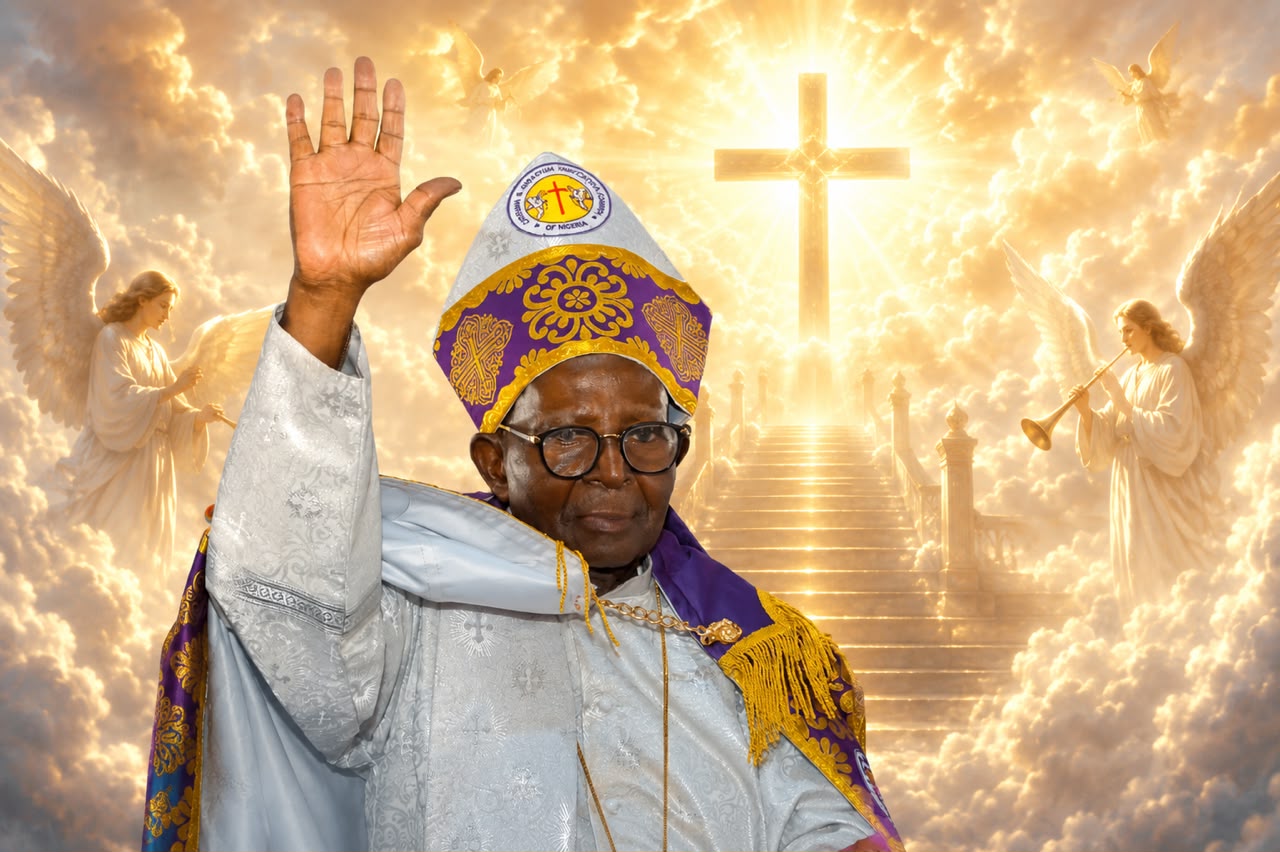

The Shepherd’s Last Symphony: The Brief, Impactful Reign Of Baba Aladura Emmanuel Alogbo
By
Segun Olatunji
The global Christian community and specifically the white garment fold, is mourning! The white garment churches of Nigeria have a rhythm all their own. It is a tapestry woven from the deep thrum of the gangan (talking drum), the bright clash of cymbals, the sweet blast of trumpets, and the rustle of pristine white fabrics swaying in ecstatic adoration. But on Thursday, July 30, 2026, that vibrant tapestry paused for a collective intake of breath. In the quiet, early hours of 2:10 am, at his serene residence in Ijaiye Ojokoro, Lagos, His Eminence, Prophet (Dr.) Emmanuel Adewale Abiodun Alogbo, JP, FNCAM, DDM, GCOMS, the Supreme Head (Olori) of the Cherubim and Seraphim Unification Church of Nigeria and Spiritual Father of the Cherubim and Seraphim Movement Church Worldwide (Ayo Ni o), breathed his last, at the age of 93, surrounded by his devoted family and lifelong domestic staff. Baba Aladura Alogbo crossed the final Jordan, leaving behind an extraordinary legacy of spiritual leadership. He was a monumental figure in indigenous African Christianity.
The official circular, bearing the heavy signature of the CSMC Secretary General, Senior Special Apostle Prophet (Dr) Anthony Olusesan Samaye, rippled across the global grid of the C&S churches, sparking a profound wave of grief mixed with deep celebration of a life well spent.
As the Supreme Head (Olori) of the Cherubim and Seraphim churches worldwide, Baba Aladura Alogbo did not just lead a church; he conducted a masterpiece. His formal time at the absolute apex of the C&S pyramid was historically brief, spanning less than three years from his initial appointment to his final transition. Yet, what he accomplished in that fleeting window was nothing short of an ecclesiastical whirlwind—a masterful blend of structural reform, radical unity and the modernisation of a global movement.
Born on Easter Sunday of April 18, 1933 at number 16, Inabiri Street, Lagos, he came from a musical family. His father, the late Dickson Adeleye Alogbo, was the choir master of Hoare Methodist Church, Yaba, Lagos. The musical heritage Baba Aladura Alogbo inherited helped to shape his exceptional talent, which later became instrumental in his ministry.
He worked for the Nigerian Railway Corporation, which he joined in 1950 and was posted to the Electrical/Refrigeration Section of its Engineering Department. He was later transferred to Zaria, Kaduna State.
The Unlikely Maestro of Zaria
Long before he wore the heavy cap and mitre of supreme authority, Emmanuel Alogbo was an artist of the spirit. His journey into the deep waters of the Cherubim and Seraphim Movement is the stuff of church legend—a cinematic moment of musical intervention. In 1959, while spending time in the northern city of Zaria, a young Alogbo happened upon a local congregation of the Cherubim and Seraphim Movement Church. They were struggling through a hymn choir rendition of one of his very own musical compositions. Unable to resist the pull of harmony, he stepped up to the conductor’s stand, gently corrected the choir’s tempo and breathed new life into the melody.
That single, impromptu interaction sparked an immediate, lifelong connection. He officially joined the choir that year, fundamentally altering the auditory landscape of Aladura worship. Prophet Alogbo’s journey was marked by a deep commitment to spiritual and musical innovation.
The Great Musical Reformation
Before Alogbo, C&S worship was a largely solemn, traditional affair. He looked at the vast sea of white garments and envisioned a symphony. He boldly introduced the Yoruba talking drum (gangan) into mainstream service worship, layered in the modern warmth of guitars, brass trumpets and organs, transforming services into a dynamic, dance-style praise experience. This sonic revolution did not just stay within the walls of the C&S Movement Church; it rippled outward, permanently influencing the praise-and-worship aesthetics of mainstream Nigerian Pentecostalism and indigenous African Christianity.
Pioneering CSMC Southern Frontier
He was not only a musical pioneer but also an aggressive builder of ministries. Prophet Alogbo’s legacy was also defined by his structural vision. In 1960, fresh from his northern experiences, he returned to a Lagos on the cusp of national independence. He realised the C&S Movement Church needed a powerful foothold in the south. On September 29, 1960, he threw open the doors of his personal residence on Cregg Street, Surulere, Lagos. That morning, a modest gathering of roughly ten worshippers huddled together for prayers. It was the formal birth of the very first Cherubim and Seraphim Movement Church branch south of the River Niger. From that tiny seed in a Surulere living room, an empire of faith grew. Today, the southern footprint of the church, which grew into a massive network, comprises thousands of sub-headquarters, mega-cathedrals, model parishes and thriving districts—all traceable back to Alogbo’s living room altar. He later established the Kingsland District of the CSMC located in Sabo Oko-Oba, Abule-Egba, Lagos and served as its Chairman until 2024 when he became the Spiritual Father of the entire CSMC.
His vision was global; he was also instrumental in establishing branches across the United Kingdom, Houston, New York and Los Angeles, allowing the Diaspora to worship with pride in their heritage, a development that has strengthened the church’s presence in the international arena.
The Lightning Reign: A Masterclass in Leadership
When the legendary fifth Baba Aladura, Prophet Samuel Adefila Abidoye, joined the saints triumphant in November 2023 at the age of 103, the church faced a monumental succession question. The mantle fell squarely on Prophet Alogbo, who was immediately appointed Acting Spiritual Head before his grand, formal installation as the 6th Baba Aladura of the C&S Movement Church Worldwide (Ayo Ni O). If the global church thought Alogbo would merely be a passive caretaker leader due to his advanced age, they vastly underestimated the prophet’s energy. His reign was short, but it burned with the intensity of a comet. It was meteoric!
In November 2024, he was conferred with the Distinguished Honorary Fellow Award of the Nigerian Academy of Church History and Missiology (FNACM). He also held a Doctor of Divinity in Missiology (DDM) from Kaduna College of Divinity. From 1959 when he joined the church until his death, Baba Aladura Alogbo spent more than 65 years contributing to the spiritual growth, administration and missionary expansion of the Cherubim and Seraphim Movement Church.
By September 2025, his leadership profile had grown so formidable that the Ecclesiastical Council, following divine directives, named him the Supreme Head (Olori) of the Cherubim and Seraphim Unification Church of Nigeria. He was magnificently anointed and enthroned at the holy ground of Seraphim Land, Km 40 Lagos–Ibadan Expressway, on September 20, 2025, becoming the fifth person to occupy the exalted spiritual office. He succeeded Prophet Solomon Alao.
Upon taking the helm, he unveiled a 10-point Agenda aimed at:
. Branding and Administration: Enhancing the church’s global image and structure.
. Doctrinal Purity and Education: Ensuring sound biblical teaching and investment in training
. Unity and Welfare: Fostering reconciliation among sub-sects and attending to social responsibilities.
. Modernisation and Stewardship: Embracing technology and ensuring financial transparency.
A Unified White Garment Church
For decades, the broader Cherubim and Seraphim Church had been fragmented into various independent factions, orders and movements. Alogbo used his rare dual position as both the head of the Ayo Ni O Movement and the Unification Church to build ecumenical bridges. He traveled tirelessly, hosting dialogue sessions, aligning liturgical calendars and reminding everyone that despite minor differences in administrative setup, they all wore the same spotless white garment.
Youth Radicalisation for Christ
Alogbo also recognised that the survival of the Aladura movement depended on the younger generation. He systematically decentralised traditional church governance, giving tech-savvy young professionals key roles in media, administration and global outreach. Under his watch, the church embraced digital streaming, making Ayo Ni O services a highly engaging, global television phenomenon.
Elevating Church Welfare
Furthermore, he strongly believed that spiritual growth is meaningless without social safety nets. During his brief tenure, he expanded the church’s internal welfare systems, ensuring that elderly ministers, widows and underprivileged students within the congregation received structured, dignified financial stipends.
To fully appreciate the swift, dynamic nature of Baba Aladura Alogbo’s leadership, one must look at how his brief reign compared to the historic era that preceded him. Though his tenure as Supreme Head was brief, his impact was profound, defined by his call to be a “servant” of the body of Christ. He was a spiritual anchor for millions, survived by his family and the vast community he mentored. While the church mourns, they also celebrate a life of immense, purposeful service.
There is an old Aladura proverb: “The garment may be folded away at night, but the white light of the spirit never dims.” Baba Aladura Emmanuel Adewale Abiodun Alogbo spent 93 years preparing for eternity, and his short time on the highest thrones of the church served as the perfect exclamation point to a life of magnificent service. He did not leave behind a church mourning in despair. Instead, he left behind a highly modernised, deeply unified and musically joyful global movement that fully understands its identity.
As the global Ayo Ni O family prepares for the grand burial ceremonies, the tears flowing across Nigeria and the Diaspora are not tears of defeat. They are tears of profound gratitude for a shepherd who ran his leg of the relay race with absolute grace, speed and unforgettable style. The great maestro has laid down his staff, stepped away from the pulpit, and joined the heavenly choir—where, no doubt, the talking drums are playing in perfect harmony. But it’s the end of an era that ended as quickly as it began for a visionary pioneer, who revolutionised Aladura liturgy, fostered deep ecumenical unity and mentored generations to secure the church’s future. His legacy is indelibly marked in the history of the indigenous African Christian faith.
.Olatunji, a Journalist, Political/Crisis Communication Strategist, writes from Akure, Ondo State