Uncle Sam’s Day In The Sun -Vanguard Book Review By Gbemiga Ogunleye
Being a review of The Vanguard Chronology: 40 years of Nigeria’s leading Tabloid, by GBEMIGA Ogunleye, fnge, on Wednesday, July 19, 2026 at the Civic Centre
Preamble
Mr. Chairman, with your kind permission, permit me to adopt the already established protocol. I thank the editors of this publication and the Vanguard alumni for this honour and privilege to undertake this task. Unknown to them, I had been a great admirer of the iconic Sam Amuka. So, when the invitation came to be a part of this book presentation, I grabbed it with both hands.
Although I did not have the good fortune of being mentored directly by Uncle Sam, he was one of those who fired my interest in journalism. As a secondary leaver in the mid-70s, I was a voracious reader of newspapers and magazines. One bright afternoon, I was reading a copy of Spear magazine, I believe when I came across an article written by SAD SAM, Uncle Sam’s pseudonym.
The headline captured my attention and imagination. I have never forgotten it. It read: O Lord, save me from my friends; my enemy I can take care of!
I then decided not only to write like Sad Sam but also to become a journalist. The rest, as they say, is history.
When Sam Amuka teamed up with his friend, Olu Aboderin to establish The Punch in the 70s, they probably had the New York Times style of management in mind. At the New York Times, the partnership of the two founders: Henry Javis Raymond and George Jones was collaborative and divided by expertise. Henry Javis Raymond was the
Founding editor, directing the paper’s tone and content, while George Jones handled the financial, business, and administrative operations.
At The Punch, Sam Amuka who had made his name as an outstanding editor and a must-read columnist at the Daily Times publications provided editorial direction, directing the paper’s tone and content while Olu Aboderin, who was the chief accountant with the then- thriving National Bank, handled the financial, business and administrative operations of the “lively paper for lively minds.”
Their partnership seemed to be made in heaven, until things fell apart between them and the centre could no longer hold!
Forced to leave The Punch, Sam Amuka , a man of the people, had faith in his talent and so went back to the proverbial drawing board.
He probably remembered one of the sayings of the sage, that “a wise person has no reason of being afraid to start all over again. At least this time, he is not starting from the scratch but from experience.”
Sam Amuka, therefore, decided that if he was going into the newspaper business again, there would be no doubt as to who was in charge.
He must have told himself that he would never surrender his dream no matter how long the journey took.
The result was the refreshingly different Vanguard which hit the newsstand in 1984.
The Review
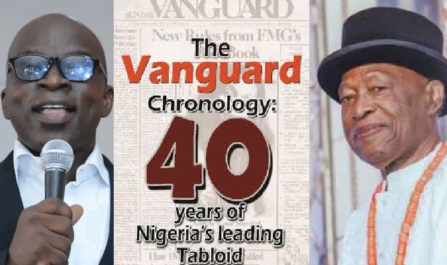
The Vanguard Chronology: 40 years of Nigeria’s Leading Tabloid is a 220-page book of 46 chapters, all contributions from some members of the Vanguard alumni and current staff to celebrate the giant strides of the newspaper and to pay tribute to the newspaper’s founder, the redoubtable Sam Amuka, better known as Uncle Sam, who has no qualms about sharing meals and groundnut with his staff at the Canal.
It boasts of seven female contributors, with legends like Helen Obviagele, Bunmi Sofola and Funmi Komolafe in the mix.
One of the editors of the book Eyobong Ita, stated the reason for putting together this book when he wrote, quoting an African proverb: “Until the Lion learns to write his own side of the story, every story will glorify the hunter, so the The Vanguard Chronology was written to ensure that a wrong story about the Vanguard is not told.”
The book, which was originally meant to be presented to the public in 2024 when Vanguard clocked 40 years on the newsstand, is a fitting testament to what is possible when young men and women share the vision of a man determined to live his dreams.
Young men and women left their comfort zone, leaving certainty for uncertainty to partake in the vision of a great journalist. The Vanguard was a place where, as one of the editors, Deba Uwadiae put it : “ a place where you can get a job without knowing anybody.”
This book is a compelling account of the challenges and the tribulations of the early years of the Vanguard.
Not surprising, the book begins with a Foreword by Uncle Sam’s friend of over 60 years, and his colleague at the Daily Times, Chief Segun Osoba. Osoba, quite aptly described his friend as a lucky man because “it is not often that a person has a second chance to succeed. Having gotten his fingers burnt in Punch, good fortune smiled on him with a second chance in Vanguard.”
The book began with an interview with Chief Ralph Ibiwoye, Vanguard’s first staff, the pioneer General manager. From Ibiwoye, we learnt that uncle Sam, flirted with the idea of being a brief case contractor. He later set up a fishing company, called the MERMAID MERCHANTS.
But the idea of starting his own newspaper kept ringing in his head.
With the support of Ibiwoye, a colleague from their PUNCH days, the Vanguard dream began. He and Uncle Sam went to Spain to buy the printing machine and moved to a submerged land in Kirikiri.
A bungalow was built, so also a warehouse for the machine. The bungalow was split into two to accommodate the editorial, the finance, and the commercial departments.
Vanguard started operations with five borrowed newsprints from the Sketch newspapers in Ibadan.
Ibiwoye who left Vanguard four years after its birth in 1988, has this to say of Uncle Sam: “Uncle Sam is a special human being created for newspapers. He knows and understands what is required in the newspaper: what the people want to read. He is very imaginative. He is very quiet but he’s very intelligent; he gives ideas, and they listen to him, and they come out well. (Page 23).
Who best to tell the story of the Vanguard than its pioneer editor, Muyiwa Adetiba! He has two articles in this collection. He titled the first one: Vanguard at 40: How it all began! It is the story of how he and his staff spent days and nights in the office to produce the maiden edition of the Vanguard which hit the street on Sunday, June 3rd, 1984.Adetiba’s
Second article is titled: Why I joined Vanguard.
As if validating Ibiwoye’s statement that “the story of Vanguard cannot be told without starting from The Punch, Adetiba stated proudly that: “Punch offered me my best years in journalism.”
If the paper did, the natural question to ask is, why did Adetiba, already a star with The Punch, with his famous Face-to- Face with Muyiwa Adetiba column leave?
His answer is a tribute to the unconventional managerial prowess of Uncle Sam; his genial nature and a man who is a good advertisement to humanity.
Listen to Adetiba: “When a man to whom you owe so much professionally and even personally- we play squash together on Sundays and attended private parties at his instance-needs you, it becomes payback time.” (Page 30).
This theme of payback time and gratitude to Uncle Sam dominate the book.
Toye Akiyode, another ex-staff of The Punch was the second editor of the Vanguard . He fittingly titled his contribution: Vanguard is Samson Amuka-Pemu and Amuka is Vanguard.
For him, Uncle Sam could do no wrong!
Frank Aigbogun was the pioneer news editor of the Vanguard.
The casual manner he was hired showed the liberal, if you like, carefree nature of the Vanguard publisher. Uncle Sad had invited him for a meeting and asked the young Frank to tell him a little about the book he was reading. As soon as Frank finished telling him about the book, Uncle Sam asked him: “When are you resuming?”
To a shocked Frank, Uncle Sam gave him a reason for his action: “If half of what I have heard about you is true, then you are the one we want here.”
Frank indeed went on to prove his mettle, rising to become the third editor of the newspaper.
Like many journalists of his generation, Frank was a no- nonsense news editor who raised his voice in the newsroom to get his reporters working. Just like almost every contributor in this book, Frank was lavish in his praise of Uncle Sam : “Uncle Sam is not just a master of the trade, he is generous…he treated you with respect as an editor or helped you to be the best you could be. I learnt many things you will never learn in a journalism school.”
Uncle Sam was to display this attribute when Frank was getting married in 1988. The publisher sent the newly wed to London for their honeymoon and gave them the key to his apartment.
Gbenga Adefaye, the paper’s fourth editor scored many firsts in his 37-year career in Uncle Sam’s vineyard! He was the first sub-editor to edit the newspaper; the first editor to be named editor-in-chief; the first editor to spend a decade on the editor’s chair and the first to be named the General manager.
His article titled: In the Vanguard of worthy causes and empathy was an excursion into the repackaging of the newspaper from its original concept of a free-flowing tabloid of an eight-paragraph news story; a 300-word editorial comment, to a “serious brand.”
Adefaye’s words, not mine. It was also an era when the newspaper championed worthy causes beneficial to the people, like the Niger Delta question, the agitation of MEND, etc.
Like others before him, Uncle Sam had a generous mention: “All the transformation and reformatting, could of course, only have been possible because of the unique style of Uncle Sam Amuka, the tolerant publisher who is a lover of good stories well told. He would support the editor to the hilt as long as you are not fingered for corruption and unethical practices.”
Adefaye is not done: “He is the ultimate brand master who insisted that the editor owned the paper to do as he wished shorn of corruption…”
The fifth editor of the paper, Mideno Bayagbon who spent 31 years at the Vanguard also had kind words for Uncle Sam: “A simple, easy-going, highly tolerant and accommodating personality that you always feel at ease in his presence.”
Eze Anaba, is the current and sixth editor of the 42-year-old newspaper.
He, too, told his Vanguard story. He joined the newspaper as an intern and recalled that Frank Aigbogun was famous for yelling at reporters, most of who were older than him. (Page 44).
Reporters who had no story avoided frank’s newsroom!
Anaba attributes his good fortune at the Vanguard to the mentoring of bosses like Richard Akinnola who headed the judiciary desk where Anaba cut his teeth and the guidance of Frank Aigbogun and of course, Everyone’s uncle, the inimitable Uncle Sam!
Anaba takes to heart words of wisdom from his mentors. From Uncle
Sam, he learnt that a newspaper is a reflection of his editor. The same Uncle Sam also told him that the main responsibility of an editor is knowing what NOT to publish!
And from Richard Akinnola came the admonition: Think like a lawyer; write like a journalist!
From the pioneer woman editor, Helen Obviagele, we learn that Vanguard was remarkable for giving prominence to women’s issues, right from inception.
Of course, columns like Women in Business; Me and my Looks; Woman’s own and Dear Rebecca are evidence of this.
Like earlier contributors, Obviagele also paid homage at the temple of Uncle Sam: “He isn’t one to hold a grudge and was always willing to give those who left his organization a second chance if they choose to return and work for him.”
Readers will find particularly interesting Ikeddy Isiguzo’s account of life at the Vanguard. He, it was, who ensured that Supreme Court judges were on the distribution list of the famous Vanguard calendar!
If you want to know almost all those who have worked at the Vanguard, both the living and the dead, then you must read his article with the title: Journalism is madness best unleashed in youth (page 57).
Ikeddy, a meticulous chronicler of the Vanguard history, also kept tabs on those who had exchanged the noisiness of the newsroom for the pastured life of politics.
This is not unexpected. He worked in the Vanguard for 27 years!
Thanks to Ikeddy, a former sports editor of the paper and chairman of its editorial board for 10 years, we now know why Richard Akinnola has kept a respectable distance from alcohol and cigarettes!
Akinnola must have taken enough at the Vanguard to last him a lifetime!
Terry Fade-Adewale, like Ikeddy, is a master chronicler of the Vanguard history. If you want to know the structure of the Vanguard newsroom and where every Vanguard reporter or advert staff sat, please read this business reporter’s account on page 74.
One of the editors of this book is Jossy Nkwocha. His baptism of fire in the newsroom as an intern is worth retelling. He had brought what he thought was a good story to his editor, Muyiwa Adetiba. Adetiba took one look at the story and flung it at him: “Who is teaching you news reporting,” the editor asked. Nwokcha appropriately titled his article: My journalism teachers at Vanguard, as a mark of appreciation to Muyiwa Adetiba, Toye Akiyode, Jimi Disu and Ely Obasi.
Nkwocha’s contribution also detailed the workings of Vanguard and the staff who worked there.
Owei Lakemfa who had lost his job at The Guardian went to the Vanguard in 1985 to see some friends. As fate would have it, none of his friends was around. But someone encouraged him to go see the publisher, an uncommon personality with a disarming humility.
When he met Uncle Sam, the publisher asked Owei to go and source two news stories and write two features for him. Owei, a consummate newsman, just sat down, wrote two news stories, handed them to the acting news editor and left.
He was shocked the following day when his neighbour, a journalist, Chris Mammah, accused him of not informing him that he had begun work at the Vanguard. One of the stories he submitted the previous day had been published. That was the beginning of a life-long relationship with the newspaper and Uncle Sam.
Owei recalled occasions when the newspaper wrote stories overly critical of the military government of President Ibrahim Badamasi Babangida. The genial Uncle Sam would chuckle and remind his editors: “DON’T FORGET THAT BABANGIDA IS MY FRIEND!”
As Owei pointed out, “as it turned out, Babangida was nobody’s friend as he did not hesitate to shut down the Vanguard in 1990,” (page 114).
On why he joined the Vanguard, Owei, a former Labour editor and columnist of the newspaper had this to say: “the newspaper was breezy, the stories were short and sharp; the editorials were concise, and the features tailored for everybody. It was a full package for the family with generous content for women and consumers. The newspaper’s motto: Towards a better life for the people resonated with my spirit.”
Funmi Komolafe, who like Owei Lakemfa was synonymous with labour reporting, titled his article: In the Vanguard of Labour.
She holds the distinction of being the first journalist to be awarded the National Productivity Merit Award. She also served on the Presidential Award Committee for a decade.
Richard Akinnola, the celebrated legal affairs journalist, carved a niche for himself not only as a guru in judicial reporting but also as a faithful patron of Abu’s bar at the Canal!
Very often at the heat of production, Akinnola would be reminded by one of his co-patrons of Abu’s bar that “Abu never balance o.”
Only the initiated knew that that was a code for him and his colleagues to quickly finish their stories so that they could go finish the beer at the Canal.
Akinnola it was who led a coup against the editor’s ban of alcohol in the newsroom. The editor, Frank Aigbogun had banned the consumption of cigarettes and alcohol in the newsroom. Akinnola led a protest to the publisher. Reporters wrote better with sticks of cigarettes dangling between their lips supported with bottles of beer, he must have argued. His motion sailed through before Uncle Sam and the ayes had it!
Theodore Opara traced his trajectory from a copy boy to a line editor who has covered many beats and has had the privilege of travelling to every continent and slept in the best hotels across the globe.
He has spent over three decades at the Vanguard.
The first time Ochereome Nnanna set foot on the Vanguard premises, he swore never to come back.
Understandably so!
Vanguard was tucked among derelict warehouses, with factories strewn along the Kirikiri Canal. Not an ideal location for the grueling demands of journalism. But 30 years later, he is still in vanguard as the chairman of the editorial board.
Dupe Singerr joined the Vanguard from her teaching job at the Nigerian Institute of Journalism. She will never forget Uncle Sam’s usual refrain: “He who fights and runs away, lives to fight another day.”
Few people can claim to know Uncle Sam better than Bunmi Sofola. For her, Uncle Sam is a very hardworking boss who suffers no fool!
“His appetite for fun is insatiable and he feels at home wherever good food is on the table.”
The cartoonist, Lawrence Akapa described the Vanguard as a family with an uncle. When he was being hired, Uncle Sam told him prophetically: “We are going to make you a star.”
Appreciating Uncle Sam
The book is deservedly dedicated to Uncle Sam , the visioner and founder of Vanguard.
Little wonder that all the contributors expressed gratitude to this unusual employer for his generosity and the manner he took them under his wings.
Perhaps only Uncle Sam would ask his reporter if he had had lunch and ask him to come along with him to the restaurant.
Only a genial and liberal fellow like Uncle Sam would go to the new office of a staff who had just resigned from the Vanguard with these soothing words: “ Young man, I came to see where you left Vanguard for. You young people are so funny. You left Vanguard for here? Anyway, just know your job is still waiting for you when you change your mind.”
When one of Uncle Sam’s editors was hesitant in taking correction, the old man had to remind the young man: “There are two things you cannot tell me anything about: women and journalism.”
I believe Uncle Sam. If you remember Punch’s page 3 girls and the Vanguard calendar with beautiful models in various stages of undress, you will agree that, certainly, Uncle Sam is an expert in women affairs!
But there is another little-known aspect of Uncle Sam which the book revealed. Thanks to Adebayo Bodunrin, Uncle Sam is a quiet crusader for press freedom. Bodunrin’s article with the title :Many things you did not know about Uncle Sam disclosed how Uncle Sam worked behind the scene, without applause to ensure that journalists who were detained in connection with the abortive Orkar coup of 1990 were released.
He ended his contribution by describing Uncle Sam as easy-going, humble, generous and a man who though apolitical, remains on top of political happenings.
Conclusion and recommendation
This well-written book, edited by the trio of Jossy Nkwocha, Eyobong Ita and Deba Uwadiae, serves as a good institutional history of the Vanguard. It is an important addition to our media history.
The reminiscences of the journalists help the reader to understand and appreciate the newsroom culture of media houses. It is in good company with the following books: Tribune at 50 (1999); Trials & Triumphs: The Story of the NEWS by Wale Adebanwi (2008); The Making of the Flagship: A story of The Guardian (2021); Uneven Steps: The story of the Nigerian Guild of Editors by Lanre Idowu, (2019; Our Punch Years, edited by Lekan Otufodunrin, (2023).
The book examines the paper’s biases, its owner’s influence, the energy of the reporters in the newsroom and of course the generous spirit and humanity of the publisher.
It is tempting to conclude that this book is the story of the Vanguard.
It is not; it is a valuable part of the Vanguard story. So, the wait continues for the story of Vanguard.
Since Uncle Sam would neither write his autobiography nor approve the writing of his biography, I therefore urge this august assembly, especially the Chairman and the Special guest of honour, to persuade Uncle Sam to commission the story of the Vanguard. That story will reveal the conception of the paper; those whom Uncle Sam shared his vision with; his state of mind after leaving The Punch; how he raised the funds to finance the paper; why and how he chose members of the Board of Vanguard; his fears about the prospect of the paper; Vanguard after Uncle Sam and the objectives of the paper, among other issues.
He owes us that obligation.
Journalism historians, journalists, researchers, lovers of memoirs, students of journalism and their teachers will find this book very useful.
One would need a microscope to spot errors in this book.
A major omission in the book is the absence of an index. Also, Uncle Sam was not interviewed. One hopes that subsequent editions would take care of these. The contributions of Fola Arogundade and Kunle Oyatomi, both former editors of the Sunday Vanguard and that of distinguished alumni like Jimi Disu, Kayode Samuel and Niran Malaolu, to mention a few should be in future editions.
Ochereome Nnanna noted that Uncle Sam was sad 60 years ago when Nigeria was still sweet.
I, therefore, take the liberty to ask: Uncle Sam, are you still sad?
I thank you for your attention!