

The NADECO Story, The Book A Whole Nobel Laureate Wole Soyinka Vouched For
TITLE: The NADECO Story
AUTHOR: Ayo Opadokun
PAGES: 509
PUBLISHER: Bonafidea Nigeria Limited, Lagos, Nigeria
REVIEWER: Felix Oboagwina
Ayo Opadokun, the acclaimed former General Secretary of the Yoruba Pan-Socio-Political group, Afenifere and General Secretary of the National Democratic Coalition (NADECO) has gone public with the last of his trilogy on contemporary Nigerian history, The NADECO Story. Coming on the heels of two others, this book maintains its uniqueness in several dimensions.
Take its launch day, for example. Chairman of the occasion was no less a personality than the Nobel Laureate himself, Professor Wole Soyinka. Yes, Soyinka showed up –and in person too! Like the blue moon, this doyen of African literature and historical pillar does not show up at just ANY event. But of course, deep will call to deep. And not only did he chair the event, Soyinka publicly endorsed the writing of Opadokun as objective, unquestionable and authentic contemporary history that accurately captured the mood, the time and the facts of which the Author wrote.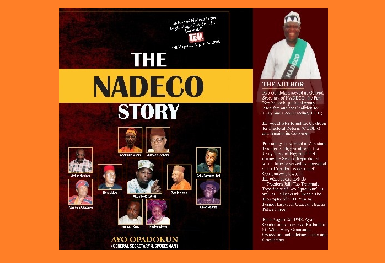
Thus Soyinka captured the soul of Opadokun’s latest work. Opadokun presents the NADECO story in a language that is simple yet sublime: Grand without arrogance. Forceful without aggression. Convincing yet unobtrusive. In it, the Author demonstrates the erudition of a Statesman and the mass appeal of a common cause.
One key element of the book is the painstakingness. Did Opadokun pour detail into this work? He sure did! The amount of research is daunting. Just like he did with The Gun Hegemony (you must read that too), Opadokun digs up documents upon documents upon documents about local and international resolutions from meetings, conferences and conventions relating to, affecting and concerning Nigeria at local and international forums as they related to June 12. Opadokun brings together resolutions from virtually all over the world, with real-life signatories. He shows that our current democracy did not come on a platter of gold (a fact unfortunately discountenanced by the prodigal, licentious and amoral conduct of the current politicians), and Opadokun’s book will not allow us forget. The price was paid in loss, fear, daringness, brokenness, blood, exile and unimaginable sacrifice. Rich men forgot their affluence. Husbands forsook their wives’ beds. Officers lost careers. The poor who had no silver to give gave their limbs and their lives in marches that dared the guns of soldiers and police.
Committed Nigerians went to prison in pursuit of this democracy. Uncountable families suffered as breadwinners fled from Abacha’s agents of gallows and graves. Many paid the supreme price. Kudirat Abiola. Alfred Rewane. Alex Ibru. Toyin Onagoruwa. These were all mowed down by Abacha’s killer squad.
From the multimedia design of its front cover (laminated, embossed and gold-foiled) to the authoritative contents, this 509-page book printed on white bond paper deserves its weight in gold. The cover spots the photo-busts of 13 eminent Nigerians. All of them, except one, are deceased. MKO Abiola is surrounded by Adekunle Ajasin and Anthony Enahoro to the top. To the right of MKO’s picture are those of Dan Suleiman, Beko Ransome-Kuti and Alfred Rewane. Depicted below Abiola are his wife Kudirat and Ndubuisi Kanu. To the West of him are Arthur Nwankwo, Abraham Adesanya and the only living one of the 13, Nigeria’s former Military Vice President, Ebitu Ukiwe.
The cover’s photographic montage could easily form a synopsis for the subject and focus of the entire book. Mischievous revisionists have taken upon themselves the otiose, vain and vainglorious labour of painting the NADECO and June 12 struggle as an ethnic struggle by the Yoruba for the actualisation of the mandate of a Yoruba man, Abiola. But the cover of Opadokun’s book tells a different story. The struggle actually exploded as a rainbow coalition project invested in by all elements of Nigeria –Yoruba, Hausa-Fulani, Igbo, as well as Northern Minorities and Southern Minorities. Even more than that, the sweat and blood of civilians mixed with those of the Military cadre to forge and drive the struggle.
Never in this country’s history had there been one voice, one common arrowhead, for nationhood, no; it didn’t happen even during the struggle for Independence. NADECO achieved that for the very first time. It weaved together the disparate strands of all Nigeria’s tribes into one strong force the world could not ignore.
With the advantage of retrospection or benefit of hindsight, Opadokun asks one crucial question that not a few Nigerians have ruminated over if not actually verbalised. Should Abiola have been left within the grasp of his enemy in the heat of that struggle? Could the struggle have been handled in another way that would have guaranteed the survival of Abiola? The Author puts it this way:
“Had we been too stubborn or too intransigent to hear? Well, maybe. But it is not easy to dismiss our doggedness in such adjectives. The nation’s pro-democratic activists –especially a rainbow platform like NADECO– projected that for the credibility of Abiola and their own credibility, they must maintain a consistent resolution not to compromise with evil. Changing midstream, especially in the context of the unquantifiable sacrifices we had made, especially when we thought ourselves so close to our goal, could reverse Abiola’s political fortunes and jeopardise our democratic struggle.
“Perhaps, if we had been a little more discerning, if we had undertaken a more studious look at the vague handwriting on the wall, if we had dispassionately interpreted the body language of key international personalities, and if we had taken a more objective look at the suggestions of those various diplomats (who often offered those suggestions informally), we could have reviewed and re-planned our stand: Perhaps. Maybe if we had been diligent enough to think through the many counsels offered to us, we would have been in the position to refocus our options. But we never imagined that anything short of Abiola’s full mandate could restore credibility to the ballot-box and satisfy our quest for democracy in Nigeria. We held it as a sine qua non, an irreducible minimum, for re-entrenching the Sovereignty of the people. We thought that in M.K.O. Abiola, in his struggle, and in his story, Africa’s most populous nation had found her own Nelson Mandela. In our mind’s eye, we had always seen Abiola moving from the prison to the palace, from his own freedom jail to Aso Rock. But we never knew our champion could fall in battle. We never considered that Abiola could be made to pay the supreme price for his democratic fervour -no, not in our wildest nightmares.”
Interestingly, with the benefit of hindsight, the Author also answers other salient questions. Why did the Yoruba race not embrace General Ibrahim Babangida’s compensatory enthronement of Chief Ernest Shonekan as head of the Interim National Government (ING) for the loss of Abiola’s mandate? If a Yoruba man lost democratically, why did the Yoruba race not just rally round another Yoruba Head of State as replacement instead of flowing along with Abacha’s plan to overthrow the Shonekan contraption? Also, why did Yoruba leaders fight for General Oladipo Diya (Chief of General Staff, who had spent the early days of the Abacha regime insulting them while defiantly organising an alternative stream of Yoruba leadership)? Instead of allowing the pompous officer to stew in his juice when he was caught in the mousetrap of what later became known as the “phantom coup” against Abacha, Afenifere and NADECO fought to save General Diya’s life. Why?
The book provides answers to such and other historical interrogations.
It does even more. Silhouetted against today’s dissonant politics of this country, the book paints an almost unbelievable utopia of Nigeria; a Nigeria where though tribe and tongue may differ, its disparate nationalities can jointly struggle to achieve one goal with one determination. Just like the June 12 election whose fruit it sought to safeguard, NADECO as a group showed that Nigeria’s diverse tribes are capable of finding a common ground and a common faith and push in one common direction for the common good of the country.
Back to the public presentation of the book on Wednesday at the MUSON Centre, Lagos: Soyinka serenaded the work and the Author.
“I must congratulate Ayo for doing an unbelievably invaluable job, giving this gift to the community and to the world at large. I have had occasion to describe Nigeria as a republic of liars. This is one instance where I would say the nation is redeemed from that reputation of permanent lying. Every page of this book, which I read carefully, rings of truth, which one can testify to personally and which carries an aura of authenticity because of the way it is narrated. It is spoken, written and documented not just from physical participation, but from research and records. Every page of it rings true.”
Can anyone give Opadokun’s book a better testimonial than this one by the Nobel Laureate Soyinka himself?

