

Seyi Tinubu And The Burden Of Inherited Castles
By
Comrade Michael Popoola Ajayi
There is an old story my grandmother once told me about a mythical kingdom called Obiripo. Whether the town truly existed or merely belonged to the moral universe of African folklore no longer matters. Like most enduring stories from our elders, its relevance lies not in geography but in wisdom.
Obiripo, according to the tale of Ifatunke my grandmother, was a remarkably prosperous land. Nestled upon fertile soil and positioned along thriving trade routes, the kingdom blossomed into a centre of commerce, influence and social stability. Its prosperity attracted traders, craftsmen, adventurers and migrants from distant territories. To outsiders, Obiripo appeared blessed by providence itself.
At the centre of this flourishing kingdom, Oba AtewolaraAjantala stood, a ruler adored across class divisions. Farmers spoke of his kindness. Merchants praised his fairness. The elderly admired his humility, while the young saw him as a symbol of possibility. Yet the reverence he commanded did not emerge by accident. It was cultivated through years of sacrifice, strategic relationship-building, emotional intelligence and political tact.
Long before ascending the throne, AtewolaraAjantala had served as Baale of a modest district within the kingdom. In those formative years, he acquired an unusual reputation: he was regarded as a man who solved problems. It mattered little whether those who approached him were allies or adversaries; he listened, intervened, reconciled disputes and extended support wherever possible. Through these acts, he accumulated something more enduring than wealth — social capital.
Over time, his network expanded beyond his immediate environment. Relationships became alliances; alliances matured into influence; influence eventually translated into authority. By the time he became king, his stature had already transcended the boundaries of Obiripo.
Then came the construction of the great castle. But the castle was never merely an architectural achievement. It was a social monument. Every pillar carried the fingerprints of collective trust. Some contributed timber, others stones. Many offered labour. Traders donated funds. Artisans volunteered skills. The people saw the project not as the king’s private ambition but as a shared investment in a man whose rise they considered intertwined with their own aspirations.
The castle therefore symbolised not simply power, but legitimacy. Like many powerful men, however, Oba AtewolaraAjantala had a blind spot: his son, Bisola.
Bisola was born into privilege already completed. By the time he became conscious of his surroundings, the struggles that shaped his father’s ascent had faded into history. He encountered influence in its finished form and mistook inheritance for entitlement. He saw the magnificent castle but never witnessed the years of negotiation, patience, compromise, disappointments and emotional labour that produced it.
Consequently, he interpreted power differently. To him, authority was less about consensus and more about proximity. Relationships became transactional. Influence appeared automatic. Gradually, he began intervening in matters traditionally governed by consultation, custom and collective wisdom. In the selection of chiefs and custodians across various quarters of Obiripo particularly in Igbodu district where his father had been a Baale, Bisola increasingly substituted institutional processes with personal preference.
At first, the elders tolerated him out of respect for his father. But resentment, like erosion, rarely announces itself dramatically at the beginning. It gathers quietly beneath the surface.
Unfortunately, the king himself was too consumed by affairs of the wider kingdom to fully appreciate the growing discomfort among those who once considered themselves stakeholders in the castle’s foundation.
The people did not attack the palace. They did something more profound: they emotionally withdrew from it. Those who once defended the castle no longer felt obligated to protect it. Those who once volunteered loyalty began to withhold enthusiasm. In the metaphorical imagination of the story, people returned to remove the contributions they had once made to the structure. The timber disappeared. The stones loosened. The foundation weakened. And slowly, the magnificent castle began to crack from within.
As contemporary Nigerian politics unfolds, it becomes difficult not to reflect upon the enduring wisdom embedded in that old story as told by Ifatunke my grandmother.
President Bola Ahmed Tinubu remains one of the most consequential political architects of Nigeria’s Fourth Republic. Supporters and critics alike acknowledge his extraordinary capacity for coalition-building, talent cultivation, political accommodation and long-term strategic planning. For decades, he invested in networks that transcended ethnicity, religion, ideology and geography. His political influence did not emerge suddenly; it was painstakingly assembled through years of patronage, loyalty management, risk-taking and institutional navigation.
In many ways, the “castle” associated with Bola Tinubu is not merely personal power. It is an ecosystem of relationships.
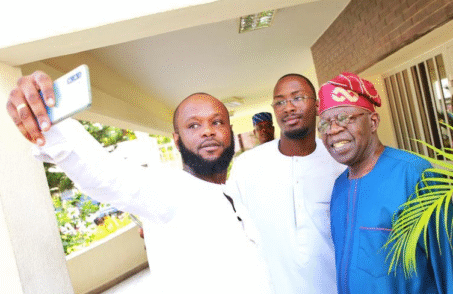
However, recent public conversations surrounding Seyi Tinubu reveal an emerging anxiety within segments of the political establishment and broader public. Fairly or unfairly, perceptions are beginning to form around the expanding visibility and influence of the President’s son within political and governmental spaces traditionally mediated by established party structures, senior, overt and covert stakeholders.
It is important to state clearly that proximity to power is not itself a crime. Across democracies and monarchies alike, political families have always exercised varying degrees of informal influence. The issue is not visibility. The issue is perception, balance and institutional sensitivity.
Political systems, especially fragile democracies such as Nigeria’s, survive largely on the management of perception. Once influential stakeholders begin to feel bypassed, overshadowed, or insufficiently respected, cracks quietly emerge beneath the surface of political stability. Such cracks are rarely visible in moments of triumph; they become evident during moments of crisis.
The danger for any dominant political structure is not always opposition from outside. More often, decline begins when internal actors unintentionally weaken the moral architecture sustaining the coalition.
History offers abundant examples. Political legacies rarely collapse because adversaries suddenly become stronger. They collapse when the custodians of inherited influence fail to appreciate the invisible networks of sacrifice, restraint, patience and accommodation upon which enduring power rests.
What built many political empires in Africa was not merely money or intimidation. It was the delicate management of ego, loyalty, inclusion, symbolism and emotional investment.
That is why wise political families throughout history often maintained an unwritten rule: heirs must never appear larger than the structure that produced them.
This is not a personal attack on Seyi Tinubu. Neither is it an attempt to deny him the rights of citizenship, ambition, or political participation. Rather, it is a cautionary reflection on the burden that accompanies inherited influence in fragile political environments.
Power inherited too early can create dangerous illusions. It can blur the distinction between access and legitimacy. It can encourage loyalists to over-perform in ways that inadvertently damage the very structures they seek to protect. And sometimes, the loudest applause around powerful families comes not from sincere allies, but from opportunists who benefit from temporary proximity.
The deeper lesson from Obiripo is therefore timeless. Castles built by relationships cannot be sustained by authority alone. They survive through humility, restraint, consultation, respect for institutions. And above all, they survive through an understanding that every enduring political structure ultimately rests on invisible human investments that cannot be commanded by force or inherited by bloodline.
Once those investments begin to withdraw, even the strongest castles may discover that their foundations were never as permanent as they appeared.
COMRADE MICHAEL POPOOLA AJAYI WRITES FROM LAGOS [email protected]

